The earlier cancer is diagnosed the better the chances are to have easier treatments and better survival.
While there are a variety of techniques and tests needed to properly diagnose cancer, in general, there are 2 main ways cancer can be detected:

The earlier cancer is diagnosed the better the chances are to have easier treatments and better survival.
While there are a variety of techniques and tests needed to properly diagnose cancer, in general, there are 2 main ways cancer can be detected:
Screening aims to detect changes and find cancer as early as possible, usually before there are noticeable changes or symptoms. It is for healthy people within the population who have no symptoms that concern them. Screening programmes for breast, cervical and bowel cancers are available for people in certain age groups.
Different signs and symptoms are associated with different cancers, but ultimately, when you notice any changes from what’s normal for you, you should get them checked by your GP.
Self-examination is a way to help us to become familiar of what is ‘normal’ for our own bodies. By knowing what it normal for you it becomes much easier to spot any changes/symptoms of cancer.
When carrying out self-examination we may be looking or feeling for changes such as lumps, swelling, changes in moles, unexplained pain or changes in toilet habits. Everyone should be familiar with their own normal as early detection of signs and symptoms can save lives.
Find out more about the Signs & symptoms of the most common cancers below.
Bowel cancer, also known as colorectal cancer or colon cancer, is any cancer that affects the colon (large bowel) and rectum (back passage). If symptoms of bowel cancer are picked up at an early stage they are extremely treatable.
Symptoms include-
For more information about bowel cancer, see Bowel Cancer UK’s short video below:
Being breast aware means knowing what your breasts look like and how they feel. If you know what is normal for you, it will be easier to detect a change.
Most breast changes will be harmless but it’s a good idea to see your doctor for proper advice if you notice any changes.
Self-examination
Breast self-examination involves looking and feeling for changes, checking in the bath or shower while you have soapy hands can help you become familiar with any changes.
Being breast aware makes it easier for you to spot new changes such as:
Start with looking in the mirror to spot any changes in the shape of your breasts. Do so with your arms by your side, above your head and then leaning forward slightly with your hands on your hips.
Then check one breast at a time with soapy hands, using the right hand to check the left breast and vice versa.
Use the flat of your fingers moving in small circular motions across the whole breast area from your collar bone, under you arms, across the whole surface of the breast including the nipple.
You do not need to squeeze or poke while self-checking- applying firm flat pressure is best.
Cancer of the cervix can take many years to develop. Before it does, changes occur in the cells of the cervix. These precancerous cell changes, which can develop into cancerous cells, do not usually have symptoms which is why it is so important to have a regular smear test, which is designed to detect any changes at an early stage (See screening section for further information on cervical screening programme).
However, there are some indications/symptoms of cervical cancer that you should check with your GP. If you notice any of the following symptoms please go to your GP for further examination.
The most common symptom is abnormal bleeding outside of your period, this can include;
Some women also have:
What causes cervical cancer?
Cervical cancer is often caused by the human papilloma virus (HPV). There are different types of HPV however not all types will cause cervical cancer. HPV is sexually transmitted and it is therefore very important to practice safe sex.
The HPV vaccine can reduce risk of cervical cancer by 70%. It is offered to 12 and 13-year-old boys and girls to protect against the two most common types of HPV virus. To be fully effective the vaccination needs to be given before the start of sexual activity.
Cervical screening will still be essential to detect changes in the cervix caused by the other types of HPV and women will continue to be invited for screening as normal.
Useful links
https://www.nhs.uk/conditions/cervical-screening
Lung cancer is one of the most common cancers that effects both men and women and can often can be present for some time before symptoms show. For this reason, it is really important to visit your doctor if you do notice any of these symptoms:
You may be more at risk of developing lung cancer if you:
Useful links
The symptoms of ovarian cancer can be very similar to those of other conditions, so it can be difficult to recognise and could also be an indication of many other conditions.
The most common early symptoms are:
Other symptoms include:
Currently, there is no screening programme for ovarian cancer, so it is particularly important to know the signs and symptoms of ovarian cancer.
If you have these symptoms you should consult your GP. It is particularly important to visit your doctor if your symptoms are persistent, especially if you are over 50 or have a family history of ovarian, breast or bowel cancer as you may be at a higher risk.
Useful links
https://www.nhs.uk/conditions/ovarian-cancer/
https://www.cancerresearchuk.org/about-cancer/ovarian-cancer
The prostate is a gland found at the base of the bladder wrapped around the tube (called the urethra) which carries urine out of the penis. It is about the size of a golf ball and its job is to produce fluid which carries sperm.
The prostate tends to grow larger with age and because of its position can cause problems with urination. An enlarged prostate, known as Benign (non-cancerous) Prostatic Hyperplasia, can usually be dealt with by medication or surgery. The symptoms for prostate cancer can be similar to those found in men suffering from an enlarged prostate but for most men there are no symptoms. Therefore, it is important that you discuss any symptoms you have with your doctor. Your doctor may recommend a blood test known as PSA (Prostate Specific Antigen). Higher levels MAY be associated with prostate cancer. Although a PSA test is useful for your doctor to determine the need for further investigation it is not used as a routine screening test.
Early diagnosis of prostate cancer can lead to very successful treatment, therefore it is important to be aware of the symptoms below. If we know what is normal for ourselves it is much easier to spot any changes.
What to look out for –
If you are experiencing any of the symptoms listed above you should contact your GP for advice or further investigation.
Useful links
The skin is the body’s largest organ, it controls the body temperature and acts as a barrier to protect our internal organs. The skin has two main layers, the outer layer is the epidermis and below this is the dermis. Ultraviolet radiation from the sun and sun beds increases our risk of skin cancer each time we burn and tan our skin.
It is important we get to know our skin and moles which will enable us to monitor and pick up any changes in pre-existing moles or should we get any new skin lesions/moles.
There are two main types of skin cancer Melanoma and Non-Melanoma skin cancer. Most commonly found non-melanoma skin cancers are Basal Cell Carcinoma and Squamous Cell Carcinoma.
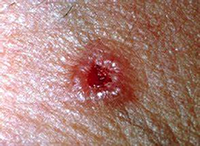
Basal Cell Carcinoma is a locally invasive type of skin cancer, it most commonly occurs on the upper two thirds of the face but commonly occurs on the trunk and limbs. Basal Cell carcinoma can present with a shiny, pearly appearance with rolled edges, ulceration and vessels than look like a branch of a tree. Basal Cell Carcinoma can frequently bleed without trauma.
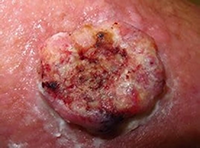
Squamous Cell Carcinoma usually presents as an enlarging crusting nodule that can frequently ulcerate. SCC can arise in a pre-existing precancerous skin lesion such actinic keratoses or Bowen’s Disease. SCC can spread through the lymph nodes to other organs; however, this is rare.
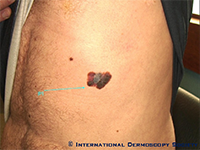
Melanoma is a less common skin cancer. Approximately 30% of Melanoma arise in a pre-existing mole and approximately 70% as a new lesion. When Melanoma is detected at an early stage the main treatment required is surgical excision. The changes that commonly occur associated with Melanoma are, increase in size, change in shape and colour particularly darker, itch, stinging and spontaneous bleeding.
As with all cancers, the earlier it is detected the more likely treatment will be successful. So, it is important to check your skin/moles once a month for changes. If you spot anything unusual for you, get it checked by your GP.
Useful links
The testicles are the male reproductive organs contained within a bag of skin called the scrotum which hangs below the penis.
Testicular cancer is a growth or tumour which appears in one of the testicles (which are commonly known as ‘balls’).
Testicular cancer is most common in men aged between 15 and 49 years of age and if diagnosed at an early stage is very treatable.
Testicular self-examination involves checking the testicle for any changes and can help you become more familiar with what is normal for you.
Support the testicles and scrotum in the palm of the hand. It is common to have one testicle slightly larger than the other, or which hangs lower than the other.
Gently examine each testicle one at a time. Using both hands, roll each testicle between the thumb and fingers.
Feel the testicle itself – it should be smooth with no lumps or swellings.
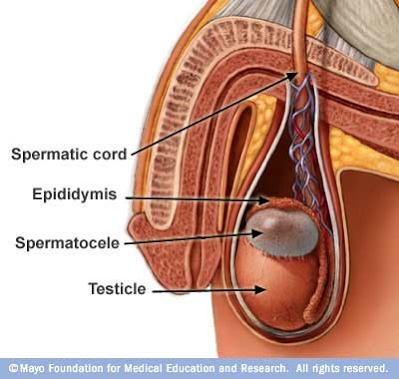
You should feel a soft tube at the top and back of the testicle. This irregular sausage-like structure is called the epididymis which stores and transports sperm. This is often confused as something abnormal however, it is a normal part of a man’s anatomy.
Check out our video on how to check yourself.
Useful links